Rethinking Access: Beyond Mobility, Toward a Smarter Way of Living
One way we will navigate out of this mire is by realizing that this is about access, not just transportation—and that digital technologies play a major role in shifting the landscape.

A lot of people trip up on the word mobility. Many people don’t see their car as part of “mobility.” In general, if we’re working from weak concepts, we’re not going to be able to solve problems—or envision true solutions.
Today in the U.S. we are living with a messed up transportation system that gets in the way of community thriving. And one of the major ways we’re going to overcome this is by understanding this is about access, not just transportation. And that the digital revolution plays a huge role in how we can rethink and restructure our transportation systems.
Access Over Mobility
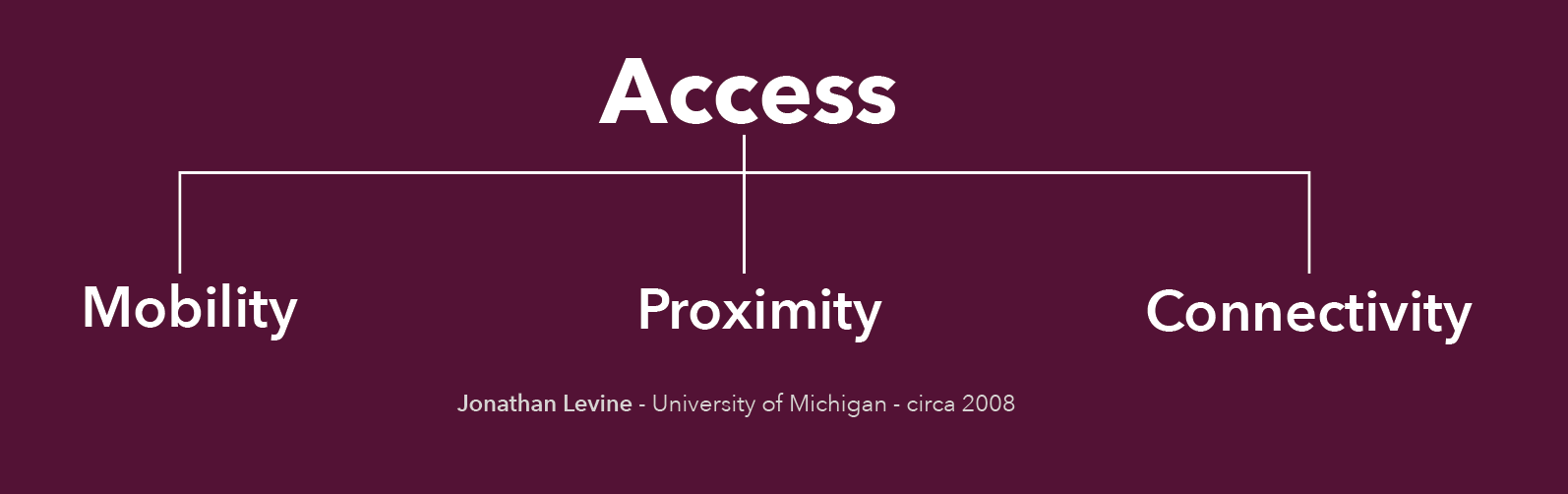
Back in 2008, I attended a New Mobility conference at the University of Michigan, organized by mobility pioneer Sue Zielinski. During one of the sessions, Jonathan Levine presented a chart that stopped me in my tracks. It showed three ways people access the world: mobility, connectivity, and proximity—all under a single, powerful heading: Access.
That word, Access, reframed everything for me.
Because when we talk about transportation—about cars, trains, or electric vehicles—what are we actually trying to do? We’re trying to access something: a job, a grocery store, a school, a friend, a good plate of tacos.
Transportation is just a tool. Access is the goal.
But the tool we most often use is a 4,000-pound car, built for 100 mph and seating five people—which is wildly inefficient for most trips. And in 2025, the tools available to us are changing rapidly.
Access Is the System
That chart I saw in Ann Arbor helped me see Access as a complete system—one that includes both physical and virtual ways to connect to our world:
Mobility: the physical movement of people and goods
Virtual Connectivity: digital access to people, services, and activities (Zoom, telehealth, e-commerce, etc.)
Proximity: how close desirable destinations are to where we live
Mobility and proximity shape our physical access to the world. Virtual connectivity bypasses movement altogether. And when all three work together, they don’t just make our lives easier—they let us reimagine how we live.
Over the years, I’ve seen a lot of “new mobility” labs and think tanks pop up. But if “Access” isn’t in the name or mission statement, they’re missing the bigger picture. Because today, how we access work, health, goods, and community is changing faster than most realize.
The Rise of Virtual Access
Let’s start with what’s hiding in plain sight: virtual access.
While automakers were focused on cup holders and autonomous lane-keeping, a revolution was unfolding—one click at a time.
Today, you can:
Collaborate with colleagues around the world via Zoom
Attend college classes online
Order groceries, clothes, and furniture—and have them delivered to your door within hours
See your doctor via telehealth
Watch movie premieres from your couch
Maintain relationships through FaceTime, gaming, or messaging
And yes, deliveries still require transportation. But it’s far more efficient to send 30 packages in one truck than to have 30 SUVs each traveling to pick up one package.
COVID didn’t start this trend—it accelerated it. Remote work, online learning, and digital services exploded, and much of that shift has stuck. The pandemic showed us what was already possible—and necessary.
Yet despite all this, we’re still building our cities around cars. Still letting SUVs dominate our streets. Still pretending that a faster commute is the holy grail of modern life.
It’s time to ask a better question: how can we access the things we need—in smarter, cleaner, more human ways?
Proximity: The Power of Near
Now let’s talk about what’s often overlooked in mobility conversations: proximity.
Access isn’t just about reaching faraway places—it’s also about designing our lives so that the things we need are already nearby. Imagine walking a few blocks to a café, coworking hub, clinic, or corner market—instead of jumping in a car every time.
Too many suburban (and even urban) neighborhoods have been hollowed out by single-use zoning and car-centric design. They’re missing what Ray Oldenburg called third places, those informal social hubs outside home and work.
But we can change that.
We can repopulate our neighborhoods with meaningful, walkable destinations:
Small restaurants and retail
Micro-mobility hubs
Shared workspaces
Local medical services
Daycares and classrooms
Libraries, maker spaces, and studios
These aren’t utopian fantasies—they’re practical, near-term moves that reduce the need to drive. They reconnect us to place and to each other.
By investing in proximity, we create new layers of physical access—not through movement, but through better design. The result? Less traffic, stronger communities, lower emissions, and a richer daily life.
The Dinosaur in the Driveway
So what’s slowing us down?
The short answer: the American car industry and car culture’s massive inertia—which still define our present circumstance with its 20th-century thinking.
Today, there are 275 million cars in the U.S. Most are engineered for high speeds and long trips, but the average American drives less than 40 miles a day, often solo. Too many of us are driving a tank to go get a taco. And although we might be inured to this oversized reality, we are paying those costs.
Even “progress” in this industry, represented by EVs, mostly preserves the old operating system. A cleaner dinosaur is still a dinosaur. It may burn less gas, but it’s still oversized, overbuilt, and often unnecessary.
And here’s the real twist: the biggest threat to the car industry isn’t another car company.
It’s e-commerce. And connectivity.
When you can order nearly anything—groceries, furniture, prescriptions, tech—to your doorstep, your need to drive shrinks. When you can work, study, and socialize virtually, your whole geography shifts.
The auto industry thinks its main threat is EV startups or robotaxis. But the true disruption? It’s already happening—delivered in cardboard boxes and downloaded over broadband.
From Movement to Meaning
So how do we move forward?
Not by choosing one tool over another, but by re-centering on Access.
We still need mobility—but we need smarter, lighter, right-sized mobility. We need better proximity—more walkable, mixed-use neighborhoods. And we need to keep building out virtual connectivity—with equity, affordability, and digital inclusion at the core.
When we prioritize Access, not just transportation, we design a future that’s more sustainable, more affordable, and more human.
Yes, the dinosaurs are still roaming. But the ecosystem is changing fast.
And for those of us shaping what’s next, Access is the map that will get us there.